in 1774 what happened to women that engaged in politics
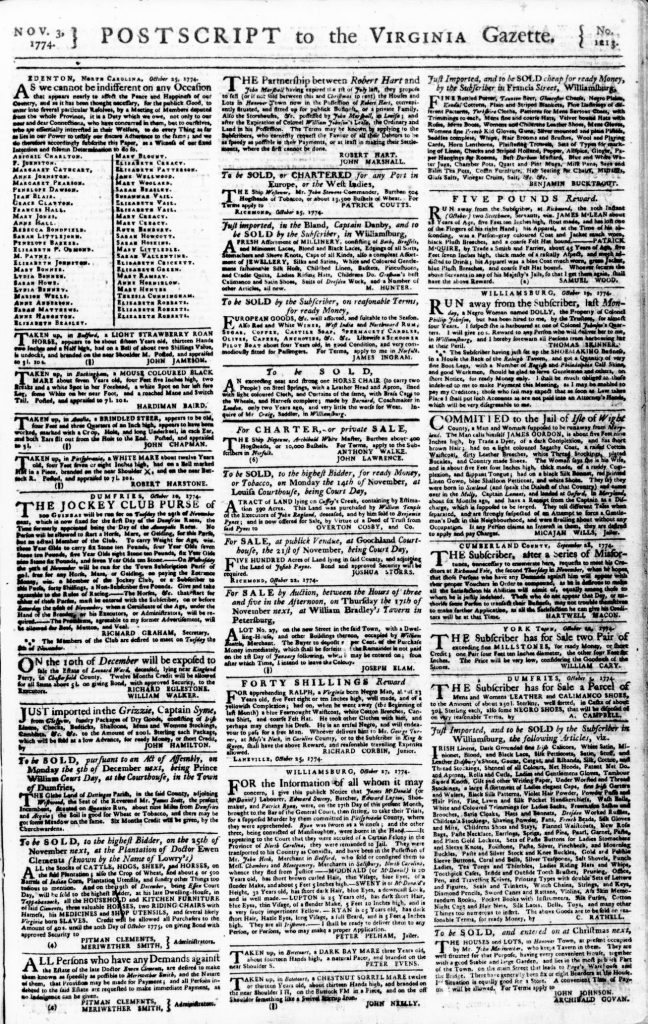
Edenton, North Carolina
"Edenton, Due north Carolina, October 25, 1774," Postscript. The Virginia Gazette (Williamsburg, VA: November 3, 1774). Courtesy of Colonial Williamsburg.
Document Text | Summary |
| As nosotros cannot exist indifferent on any occasion that appears nearly to affect the peace and happiness of our state, and as information technology has been idea necessary, for the public expert, to enter into several particular resolves by a meeting of Members commissioned from the whole Province it is a duty which nosotros owe, not only to our near and beloved connections who have concurred in them, but to ourselves who are essentially interested in their welfare, to do everything as far as lies in our ability to prove our sincere adherence to the same; and we do therefore appropriately subscribe this paper, every bit a witness of our fixed intention and solemn conclusion to do so. | We cannot ignore events that affect our land. The leaders of our state have decided to protest the actions of our government. We believe nosotros have a duty to speak out. We owe it to the men who lead us, our husbands and fathers, and we owe it to ourselves. We sign this paper to show that nosotros will practise anything necessary to support their protests confronting the government. |
"Edenton, North Carolina, October 25, 1774," Postscript.The Virginia Gazette (Williamsburg, VA: November 3, 1774). Courtesy of Colonial Williamsburg.
Background
In the 1760s, the British government needed to find new means to pay for their costly victory in the French and Indian State of war. First, they began enforcing the trade regulations that governed their North American colonies, not bad downwardly on the smuggling of foreign goods that had been a part of the colonial economy for decades. Then, in 1767–68, British Parliament passed a series of five acts known as the Townshend Acts. These placed taxes on drinking glass, lead, paints, paper, and tea. The coin raised from these taxes was supposed to offset the cost of defending the colonies. But they were very unpopular in the American colonies, who believed the trade regulations the government forced on them were already plush enough. When the new taxes were implemented, colonists refused to buy any British appurtenances at all.
By 1773, the British E Republic of india Visitor was in danger of going broke. To help the East India Company, Parliament passed the Tea Act of 1773. This law allowed the company to sell tea directly to the colonists without having to employ middlemen. This fabricated their prices so low that they were cheaper than any other foreign seller, fifty-fifty with the taxes. The government probably expected that the colonists would be happy to take a perfectly legal, very inexpensive tea to purchase. Instead, the colonists were furious at what they saw as a further corruption of power, and new protests swept the colonies. The Boston Tea Party is the nigh famous Tea Act protest.
Virtually the Resources
Tea was the almost pop potable in the English colonies, and acrimony over the Tea Act of 1773 did not go abroad quickly. Throughout the spring and summer of 1774, women across the 13 colonies were asked to stop buying tea to show their displeasure.
But not buying tea was not enough for the women of Edenton, North Carolina. On Oct 25, 1774, 50-one women gathered at the dwelling of Elizabeth Rex. They named their group the Edenton Ladies' Patriotic Gild, and wrote and signed a statement about their decision to not purchase tea. They explained that they were not just doing it because the men in their lives wanted them to, but because they felt it was a duty they owed themselves as concerned citizens. It was the first time in the history of the British colonies that women came together to brand a public political annunciation. It was published in newspapers all over the colonies and England, and information technology caused strong reactions in all who read information technology.
Vocabulary
- act: Law.
- middlemen: People who buy goods from one person and sell them to another.
- smuggling: To secretly bring illegal goods into a country.
Pronunciation
- Edenton: EE-din-ton
Discussion Questions
- What reasons exercise the Edenton Ladies' Patriotic Guild give for their back up of the cold-shoulder?
- Why were women disquisitional to the cold-shoulder of British goods?
- What makes this document remarkable enough that it was republished throughout the colonies and in England?
- How does this document change our agreement of women'southward roles in the political unrest before the American Revolution?
- Why was the Boston Tea Party remembered and commemorated, while this event has been widely forgotten?
Suggested Activities
- Combine this certificate with the political cartoon "A gild of patriotic ladies" for a lesson about women's political action and public response.
- Newspapers were the best way to spread a message to a large audition in 1774, but today social media is a critical tool in political campaigns. Inquire the students to revise this declaration for a modern-day social media platform.
- Invite the students to write and act in a brusque play almost what the meeting of the Edenton Ladies' Patriotic Club was like.
- Teach this document together with whatever of the following for a lesson on the many means women expressed their political opinions during the American Revolution, and how their actions were received: Spinning Wheels, Spinning Bees, A Call to Artillery, Political Caricatures, Sentiments of an American Woman, and Abolitionism and Revolution.
- Teach this certificate along with whatever of the following for a lesson about the many ways women actively participated in both sides of the American Revolution: Spinning Wheels, Spinning Bees, A Call to Arms, Sentiments of an American Adult female, Life Story: Margaret Corbin, Life Story: Lorenda Holmes, Life Story: Margaret "Peggy" Shippen Arnold, and Life Story: Nanyehi Nancy Ward.
- Enquire students to research the women who signed their names to this petition, and consider the role race and grade played in their ability to take this unusual step.
Themes
ACTIVISM AND SOCIAL CHANGE; DOMESTICITY AND FAMILY
New-York Historical Order Curriculum Library Connections
- For resources relating to the American Revolution in New York, see The Battle of Brooklyn .
Source: https://wams.nyhistory.org/settler-colonialism-and-revolution/the-american-revolution/edenton-tea-party/
0 Response to "in 1774 what happened to women that engaged in politics"
Post a Comment