what are the benefits of learning to juggle on achievement?
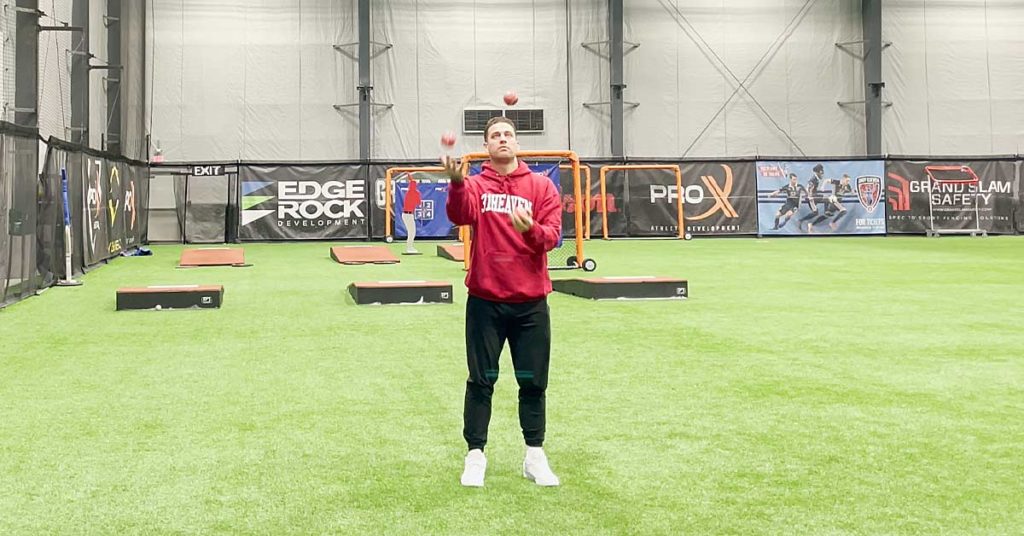
It's extremely rare that I'll make a merits similar this i skill tin can help ALL athletes improve considering just saying it out loud sounds similar clickbait. But here we are…
I'll go right to the indicate. Juggling. Yes, juggling is the one skill that all athletes can benefit from.
There is no ane-size-fits-all arroyo when it comes to the methods with which we train our athletes. Athletes are too different for in that location to be one best style to exercise things. This is why I said it's very rare for me to claim that this one thing can assist all athletes. But in the case of juggling, information technology is really one of the exceptions.
Before nosotros swoop deep into the key benefits—hand-eye coordination, brain development, sport specificity, and motor learning—nosotros must wait at the large flick from a 30,000-foot view.
It's universally accepted that the #1 chore of a forcefulness motorbus is to exercise NO harm. So, our job is to implement whatever strategies nosotros feel are appropriate to elicit a training response with no impairment washed to our athletes. This means nosotros must constantly evaluate the risk versus reward of our program.
Juggling is, by far, ane of the most harmless training modalities I've ever come across, with a meaning upside and potential for positive outcomes, says @JustinOchoa317. Click To Tweet
Juggling is, by far, one of the most harmless training modalities I've always come up across, with a meaning upside and potential for positive outcomes. This is why I feel so confident in maxim that, literally, all athletes tin benefit from learning this task.

How It All Began
This all started in the gym when one of my athletes randomly started juggling betwixt his sets of deadlifts. I idea to myself, "That's actually a really good idea."
In the past, I have played around with vestibular and cognitive challenges every bit a residue catamenia betwixt sets:
One of my favorites was to have the athlete close their optics, and then throw them two different balls and shout out the name of a colour. The claiming was to open their eyes when they heard the color, track the brawl, and catch it. I found that these pocket-sized games had multifaceted benefits.
First, you obviously get the visual and cognitive benefits. But you also get an first-class fatigue monitoring system built into the games. When athletes are more than fatigued, their vestibular system won't be as sharp. They often bollix or drop the ball. As they recover from the set, they starting time to improve their performance. This indicates that the system is restored and set for the side by side gear up.
Juggling in this context never crossed my mind. Why? Because I couldn't juggle and had never even attempted to. But something almost how like shooting fish in a barrel my athlete made it look that day and how much fun he was having doing it made me want to attempt.
I tried. And I sucked.
When I effort new things and suck at them, you tin can basically guarantee that I will become obsessed with whatsoever that thing is until I figure it out. And so, I did.
I learned how to juggle, practiced, and eventually got pretty good. And then, my wheels started to plow with ideas on how juggling could be beneficial given some general background of the known benefits. Here are 4 of those benefits.
1. Manus-Eye Coordination
The about credible benefit of juggling is the improvement in hand-eye coordination. This also has the most significant impact on sports performance. Yous'd have to look far to notice a sport where improving hand-eye coordination wouldn't be a benefit.
The near apparent benefit of juggling is the improvement in paw-middle coordination. This also has the near significant impact on sports performance, says @JustinOchoa317. Click To Tweet
Also, beyond sports, improving hand-centre coordination is never a bad idea. This could help with daily tasks such every bit driving, multitasking, and even using the handheld devices that are such a big part of our society today.
The starting time day I tried to juggle and failed, I decided to brand myself into a case study. I used the Blaze Pod light reaction organization to test my hand-centre coordination. This was my report on that day.
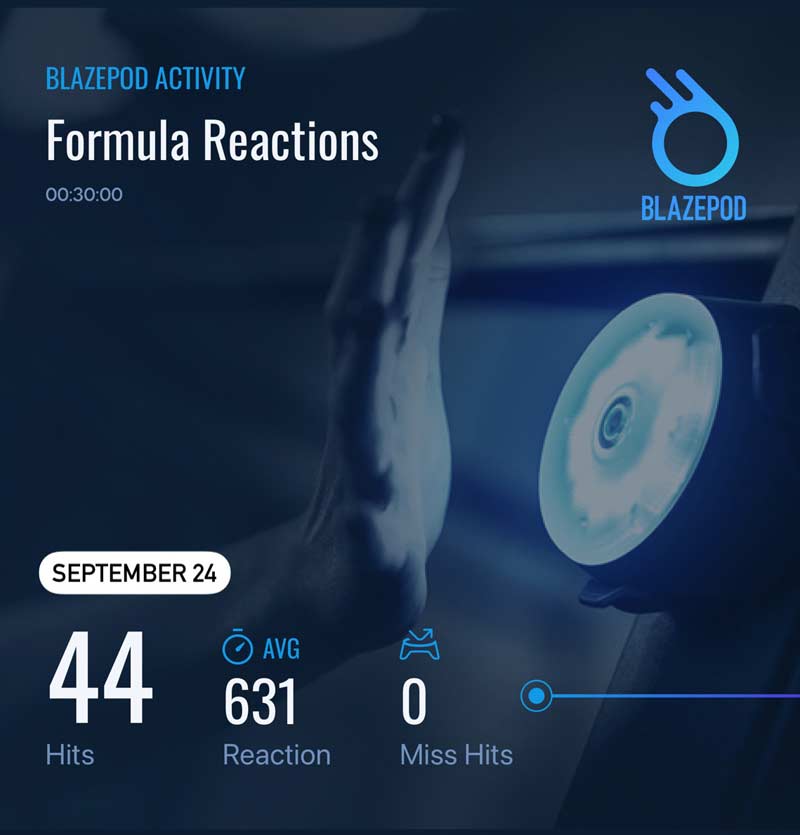
I practiced juggling for 10 minutes a day for i month and then retested. Not only did my juggling skills ameliorate significantly, merely so did my hand-eye coordination. I inverse zero else about my life or my training than the fact that I introduced juggling.
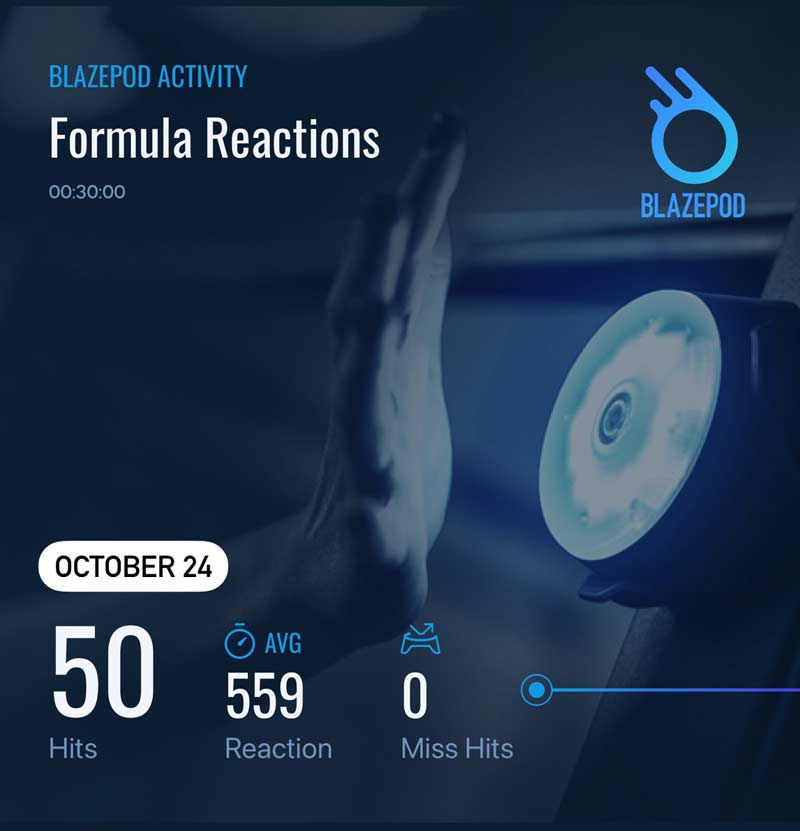
This wasn't performed in a lab, nor is information technology a published inquiry project, but it tells me pretty clearly that juggling has positive effects on paw-eye coordination.
And, just to make sure it wasn't all newbie gains, I went ahead and went 1 more calendar month and did another test. Sure enough, I kept improving. This time, my score improved to 56 hits and an boilerplate reaction time of .498 seconds.
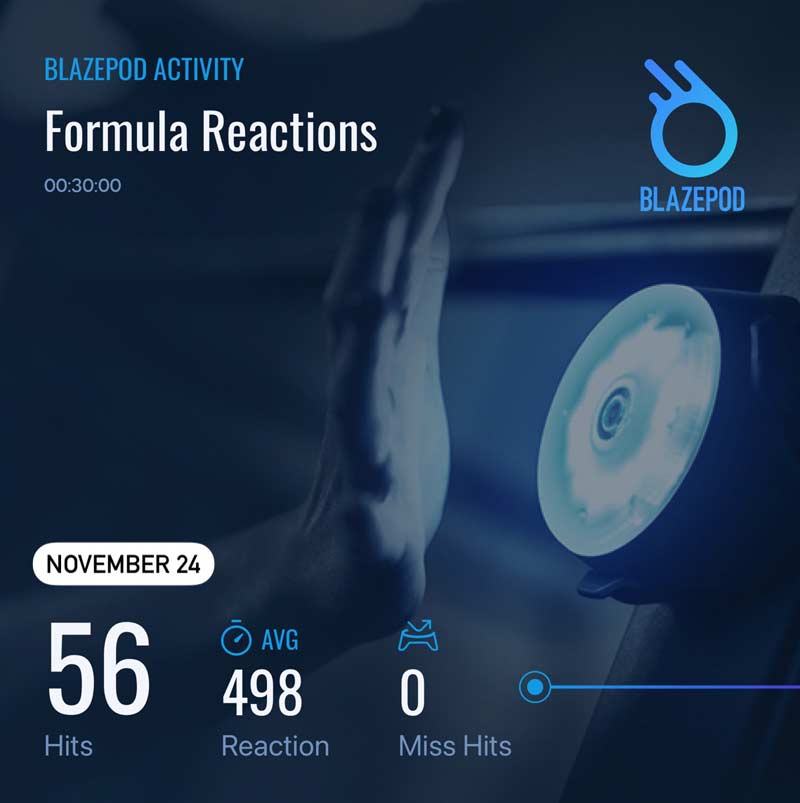
In just x minutes a day, accumulating absolute zero fatigue, soreness, or injury risk, I was able to improve a universally sport-specific attribute. As discussed in the introduction, if you lot don't have 10 minutes to spare, you can simply work it in between sets or throughout the day.
In just 10 minutes a day, accumulating accented zero fatigue, soreness, or injury risk, I was able to improve a universally sport-specific attribute, says @JustinOchoa317. Click To Tweet
Furthermore, even though I am a washed-up double-decker at present, I still play basketball game at a pretty high level 1–2 times per week with a solid group of ex-college and pro players. Anecdotally, I have noticed myself making much ameliorate reads and passes with my nondominant hand—something that truly stands out considering I had been dealing with a broken finger on that hand.
This gave me the ultimate confidence to implement this with all my athletes, regardless of sport or age. And they're all seeing similar results. Many of the skill development specialists in our facility—such as wide receiver coaches and hit instructors—are also implementing juggling and noticing the same improvements with their clients.
2. Brain Development
The deeper scientific discipline and research on juggling and its effects on brain evolution are genuinely fascinating. My instance study to a higher place was me only beingness curious and operating on a hunch—one time I realized there were positive results, I started to dig up actual research in this realm and was really blown away past the findings.
Many studies on brain development revolve around grayness matter, which has proven links to our memory and focus. Gray affair is fabricated of neuronal jail cell bodies and conducts and processes information to send to other trunk areas.
Although gray matter is thought to be fully formed by our twenties, nosotros can still enhance it after that age, as proven by a brain study performed in 2008.1 Researchers tested 20 participants with an boilerplate age of 26.5 years erstwhile to investigate the nervous organisation's adaptive behavior to learning a new skill.
That skill? Juggling.
The researchers were able to confirm training-induced gray matter changes in the brain. They constitute a significant increment in brain gray matter during the exercise and in the short term after the report. In that location was no conclusive data for what happens to this gray affair later three months or after the skill is forgotten. Nonetheless, participants grew their brain's gray matter, which unlocks a ton of potential for other motor learning tasks.
Researchers found a significant increase in participants' brain gray matter during juggling and in the curt term after the study, says @JustinOchoa317. Click To Tweet
Amazing correct?
What's even more impressive is that researchers in a different written report found the first-ever evidence of training-related changes of white thing in the man brain just a year after.ii White matter constitutes the other "matter" of our brain. Fabricated of axons and myelin, white affair is found in the much deeper tissues of the brain compared to greyness matter. White matter interprets sensory information and has not been studied at the level that grey matter has.
In this study, juggling was again used as the preparation methodology. Researchers provided juggling materials to 24 participants, who were to practice for 30 minutes per day, and they had a control group of 24 participants who did non juggle. Both groups had MRI scans before and after the experiment.
Later six weeks, the non-juggling grouping did non show any changes in the brain's white thing. However, the juggling grouping showed growth in the white affair expanse of the brain, especially in areas related to vision and movement. What's also interesting is that fifty-fifty the jugglers who had not notwithstanding mastered the task nonetheless saw the same benefits simply from trying to larn the new job.
I am no brain specialist by whatever means. Still, the positive changes that the actual brain experts are seeing in their studies—and the fact that they're using juggling as a means of training—should speak volumes to just how impactful juggling can be for our brain development at any age.

3. No Limitations
Another great benefit of juggling with our athletes is that there are truly none of the limitations that exist in other aspects of sport. Meridian doesn't matter. Speed doesn't matter. Experience in sports doesn't matter. It's only express by the time you put into it. A prime example is Casey Boehmer, a earth-renowned juggler who only has one arm.
I actually like this aspect of juggling because it'southward an excellent tool for teaching conviction to athletes who may need some small victories of their own. For case, you lot could teach a below-average athlete who lacks confidence to juggle. They can learn the skill, outdo the "ameliorate" athletes in the group, and immediately proceeds conviction from that small personal victory. That could lead to more and more gains in other aspects of their game and training. Confidence has a unique snowball effect.
Considering juggling has none of the limitations that be in other aspects of sport, information technology's an splendid tool for pedagogy confidence to athletes who may need some pocket-sized victories of their ain. Click To Tweet
Although juggling is not a sport skill that appears in any sport, information technology enhances the qualities we use in several sports. This is the same as juggling with everything but your hands in the soccer globe. All great soccer players master juggling the ball; it showcases rhythm, coordination, kickoff touch, and body control. Simply it volition never happen in a game, and that's okay. It builds qualities that will occur in a game.
The same goes for dribbling tricks in basketball game. Athletes don't practice complicated trick dribbling routines to employ the exact routine in a game only to challenge their paw-eye coordination, balance, rhythm, and brawl control, so the simple moves they utilise in-game are maximally efficient.
Perhaps the instance that drives the indicate home the about is a boxer using a speed bag. Have you ever seen Mike Tyson punch another human being similar he punches a speed bag? No, never. Tiny punches with the back of your fist aren't going to knock anyone out, but the speed bag builds upwards the mitt-eye coordination, hand speed, and upper body endurance that are crucial for fighters.
As coaches, we need to sympathise that non all grooming will look precisely like the sport. But as long as the result of the grooming volition enhance our sports performance while doing no impairment to the athlete, the juice is worth the squeeze.
4. Rhythm and Coordination
Finally, the rhythm and coordination that you experience with juggling can greatly acquit over to other training modalities or sports. I of the keys to juggling that I've had success with is making it a whole-torso motion. I find that when I get my knees and ankles bouncing with the rhythm of my catches and throws, I feel the well-nigh locked-in.
It's no different than a basketball game player using rhythm to modify their step on a drive to the basket or a marathon runner finding a adept stride and rhythm during their run. And so much of athleticism is based highly on rhythm and coordination, and this is a really elementary way athletes can raise that quality.
All the things covered and then far—hand-eye coordination, encephalon development, confidence, coordination, and rhythm—are universally sport-specific.
Juggling will not brand you meliorate at your sport. The benefits that athletes accomplish through juggling can help raise their ability to perform the skill of their sport at a higher level.
This could lead to improved passing, ball handling, or defensive outputs for basketball. For a wide receiver in football game, this could atomic number 82 to better brawl tracking and catching ability because that is precisely what juggling is—it's merely a different ball. For baseball/softball, we could see an improvement in hit and fielding.
As I said, information technology would exist challenging to try to name a sport where these neural improvements aren't worth 10–30 minutes a day of non-fatiguing training like juggling.
Lastly, lawn tennis balls and lacrosse assurance take become very common in the sports performance world equally reactionary tools. These are tools we all have lying around the gym.
A simple drill I love is the ball-driblet exercise, where a coach drops the ball to start the drill, and an athlete sprints to catch the ball to complete the movement. Or the jitney drops two balls and calls out a command for which one to catch. These are groovy reaction, speed, and agility drills. While the balls are out, why non juggle them to recover between sets?
These drills piece of work all aspects of the system and genuinely get the most from our time with the athlete.
How to Juggle
All these benefits are fantastic, but the question remains…how the heck practise you juggle?
I am by no means an expert juggler or juggling instructor, just I managed to teach myself in just a few days. At kickoff, information technology was a crude learning bend, but I eventually got to a indicate where I could manage to do some tricks and juggle for long durations with no drops. Below is how I learned and how I've been pedagogy my athletes, broken down into very uncomplicated steps.
Tip: Start with a solid, moderately weighted ball about palm size like a baseball, edible bean pocketbook, or hacky sack. I don't recommend using lawn tennis balls to start.
Stride 1: 2-Throw Commutation
Video i. Step 1 is what I call a two-throw exchange. This will involve two throws and a controlled catch, repeated over and over.
Start with 2 assurance in your dominant hand and one brawl in the other. With your dominant hand, toss 1 ball into the air. While that brawl is airborne, toss the ball in the nondominant hand to free upward that hand to catch the first ball thrown. Catch the get-go ball in the nondominant hand and then the 2nd in the ascendant manus. You lot should end upwards right back at foursquare 1, with two assurance in 1 mitt and one in the other.
This will build your full general timing and go the blueprint down for eventually juggling. Throw, throw, catch, grab, and so reset. Do not blitz between reps. Care for each one equally a single rep to get a experience for how difficult and high you demand to throw the assurance.
Step 2: Three-Throw Commutation
Video 2. Building onto our two-throw commutation, you tin can progress into a three-throw exchange. This starts the same as step 1, but you'll add together an actress throw and so again terminate with a controlled catch.
So, you'll throw the ascendant mitt, nondominant, then dominant hand again and catch the assurance. At present, you should end up with two balls in the nondominant hand and i in the dominant hand. If you want, yous can start the next rep from this scenario, flipped from how you started, or reset all the balls and get once again. Personal preference.
Footstep 2 is a complete cycle of ball motility and the exact move you'll need to principal to movement on to step iii.
Step 3: Time Goals
Video three. Y'all repeat the iii-throw exchange in this step merely never catch the assurance. Simply keep the wheel going.
A simple rule that helped me put it all together is that you accept to throw one to take hold of one. There will always be a ball in the air, and to grab it, you must toss one upwardly to brand room in that hand. If yous merely adhere to this elementary dominion, it will all come up together for you in footstep iii.
The purpose of step three is to reach fourth dimension goals. I started with 15 seconds with no drops. That'south a major milestone. Later that, 30 seconds with no drops is the next milestone. These are not easy tasks.
Information technology's frustrating. I once practiced for 30 minutes direct without getting a 30-2nd unbroken streak. But the reps add up, and one day it will click for the athlete.
Stride 4: Space Goals
The final step is calculation a infinite goal or a space constraint. Sometimes, yous have to chase the balls effectually to continue them in flight, especially when trying to achieve a time goal. This is more survival mode than juggling.
Adding a space constraint forces the juggler to focus on brawl command and trunk awareness. The smaller the space, the harder it is.
You tin can offset with a designated surface area using tape or cones to provide out-of-bounds lines, and then motility to tighter spaces like standing inside a tractor tire or hula hoop.
I've even been experimenting with long-elapsing isometric holds while juggling, says @JustinOchoa317. Click To Tweet
I've even been experimenting with long-duration isometric holds while juggling. Holding a divide squat or wall sit or balancing on one leg is a different abortion when you're besides trying to successfully juggle for minutes at a time.
Bringing It to Your Facility
I realize that this article may non be for everyone—we all coach in unlike environments and have our ain situational challenges in our setting.
With that said, I highly recommend introducing juggling, if at all possible. The benefits we've seen in a short time have been extremely impressive. Non to mention, information technology's such a fun action—even if you're not good, it's oddly satisfying just to continue to try.
We run across a lot of circus tricks these days from trainers on social media, but this circus trick is really a beneficial i.
Since yous're here…
…we have a small favor to ask. More people are reading SimpliFaster than ever, and each calendar week we bring yous compelling content from coaches, sport scientists, and physiotherapists who are devoted to edifice better athletes. Please accept a moment to share the articles on social media, engage the authors with questions and comments below, and link to articles when appropriate if you take a blog or participate on forums of related topics. — SF
References
1. Driemeyer J, Boyke J, Gaser C, Büchel C, and May A. "Changes in Gray Matter Induced by Learning—Revisited." PLoS ONE. 2008;3(7):e2669.
2. Scholz J, Klein One thousand, Behrens TEJ, and Johansen-Berg H. "Grooming induces changes in white-matter architecture." Nature Neuroscience. 2009;12:1370–1371.
Source: https://simplifaster.com/articles/juggling-skill-athlete-benefits/
0 Response to "what are the benefits of learning to juggle on achievement?"
Post a Comment